
Location, location, location
Role: UX collaborator, representing the employer GM
Participants: Product, Engineering, UX collaborators
Timeline: 6 months
Results: Cross-GM coordination on high priority items
Location is a key consideration when looking for the right job, or the right job seeker. The most common job search on Indeed is for job seekers looking to find jobs near them, regardless of the job title. However, location mismatches generate a large percentage of overall negative feedback from both job seekers and employers.
Where are these mismatches coming from and how can we prevent them?

Understanding the problem
The location problem space is complex, spanning several GMs and product spaces with multiple issues throughout. There is not a singular, or simple solution.
The first thing we did was map out the landscape. To do this, we interviewed SMEs from across the business, collected existing data, and reviewed previous research, designs, and test results. There was a lot to unpack!
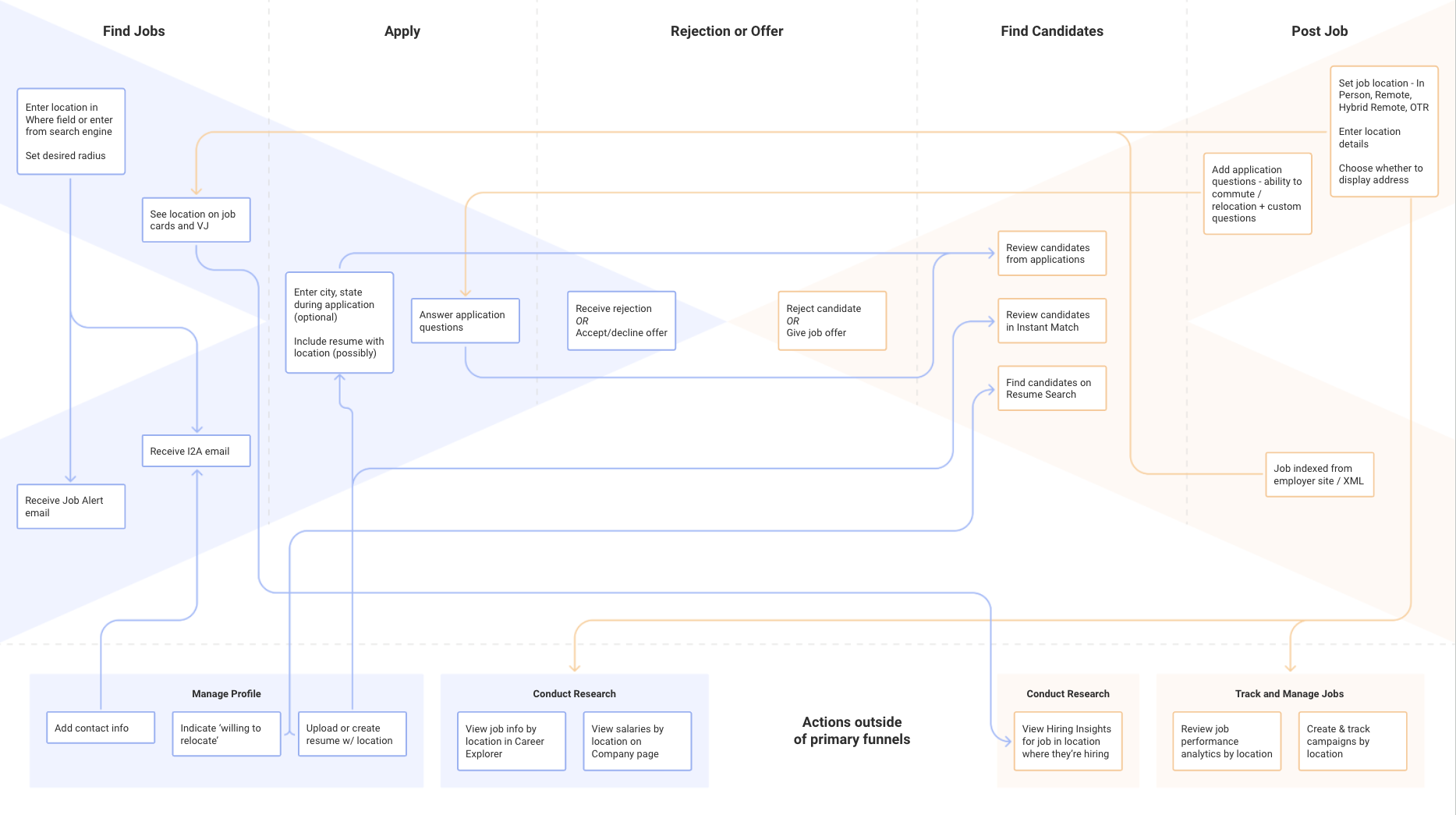
From there we synthesized the information and identified three key challenges

Location matching
Job seekers can’t easily find jobs that fit within their location needs

Complex location types
Indeed only supports a limited range of location types on both the frontend and backend today

Push/pull
Employers and job seekers have preferences that have to be balanced
Location matching
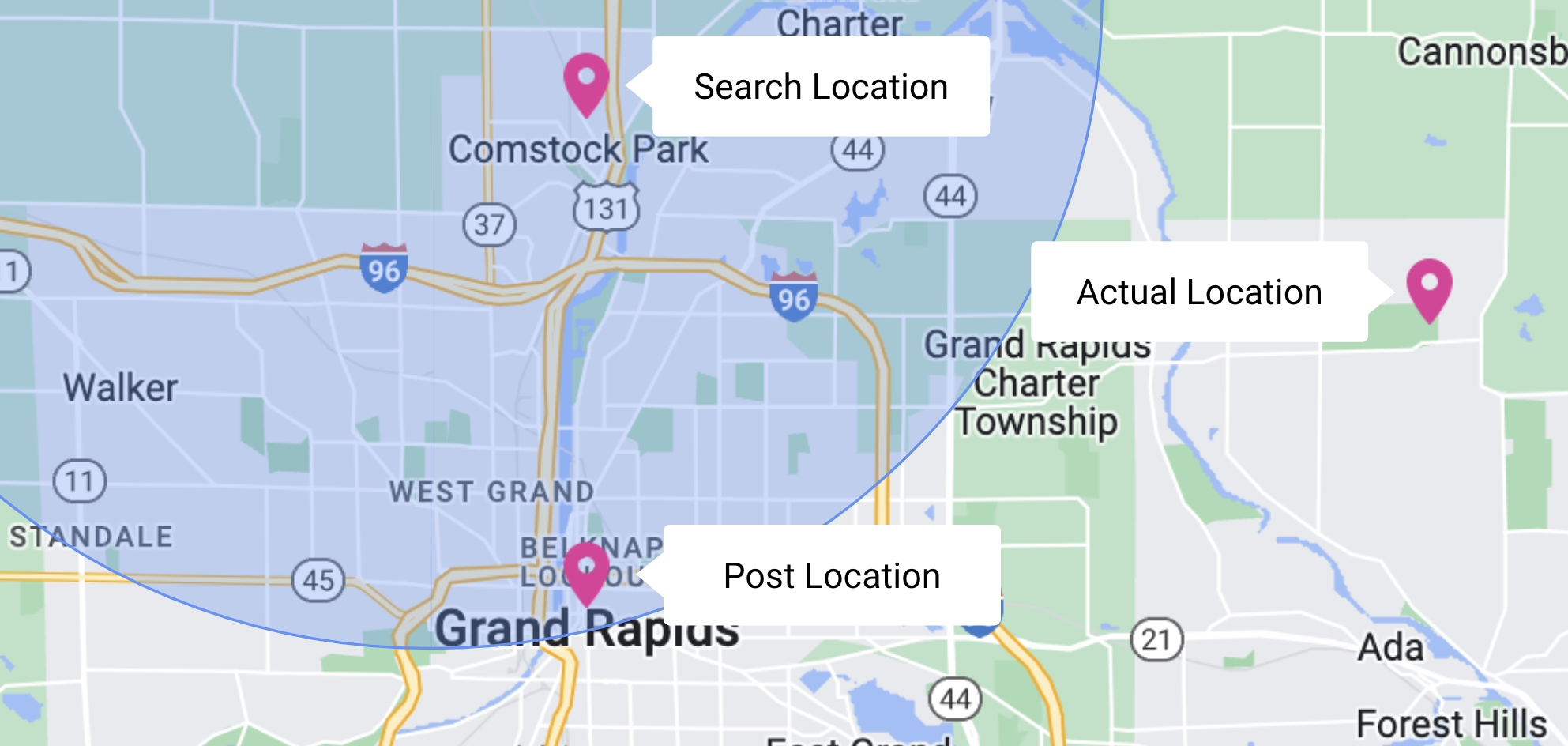
We aren’t always able to capture the exact location of the job seeker or the job. 40% of job seekers* have provided an exact location. Sometimes we also infer job seeker location, but this may not get it right. Roughly 50% of jobs have an enhanced location - it can be especially difficult to get precise data for indexed jobs. And how location is assigned when enhanced location is not available can lead to irrelevant results.
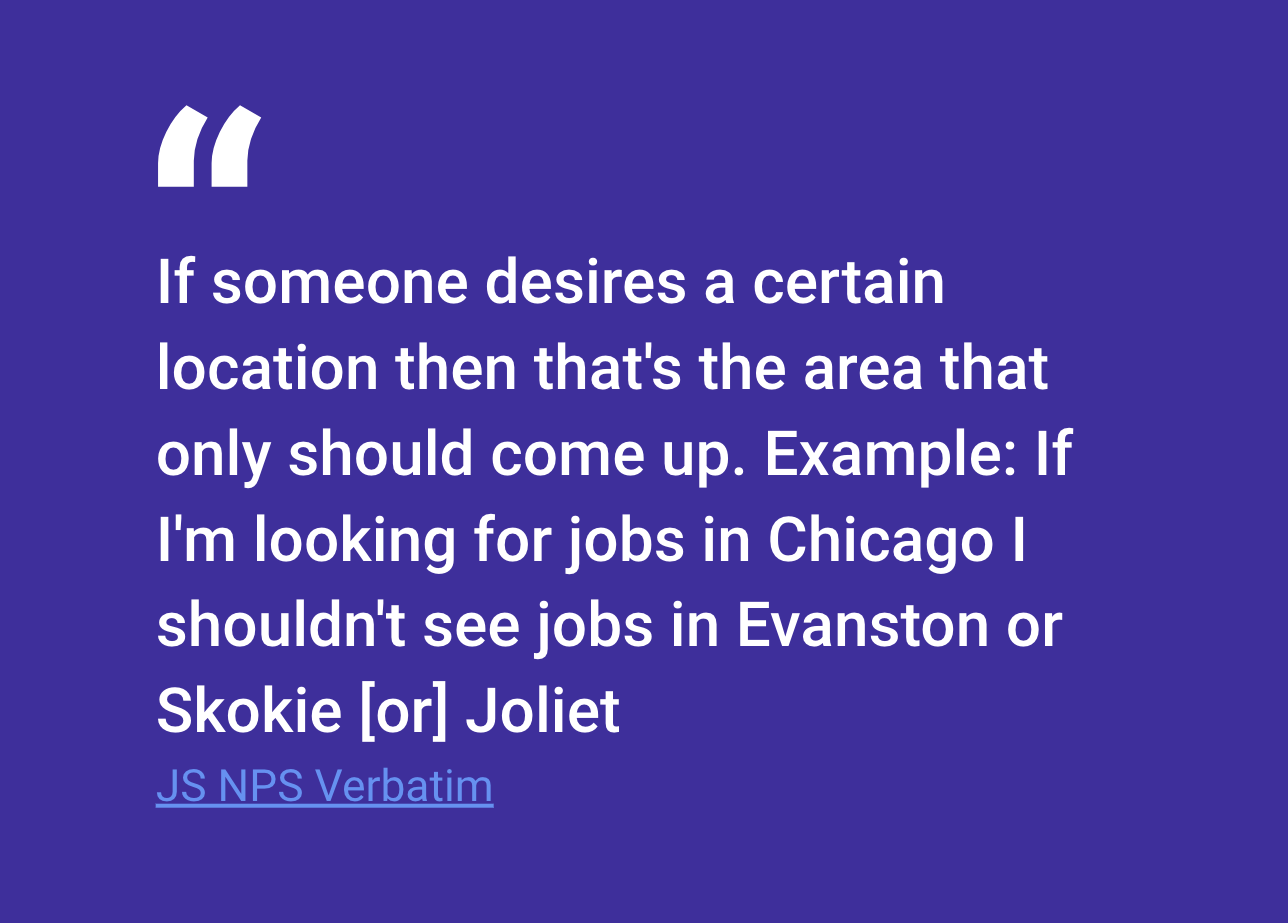
Job seekers don’t have the tools to deeply personalize and control location. The way that job seekers think about location is complex, but we only support single location search and a basic search radius. Job seekers aren’t able to see their search radius, so they may get results that are technically in radius, but don’t match their expectations.
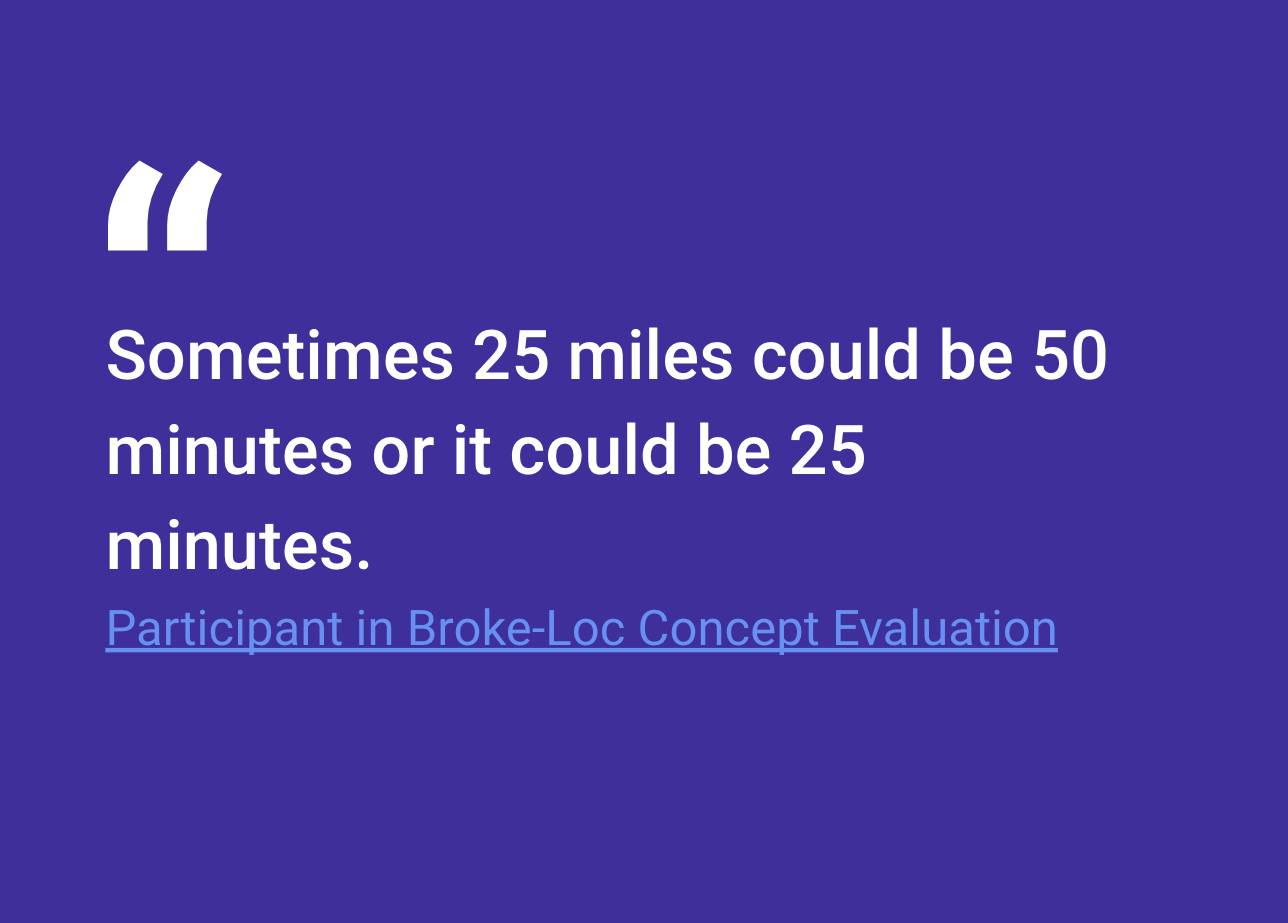
Searching by commute is helpful, but it’s also complex and nuanced. Today job seekers leave Indeed to see if they can commute to a job, but there are challenges with bringing commute to life: Requires the precise location of both the job seeker and the job Complexities with differences in traffic by time of day, route, tolls, cost, and transportation mode Calculating commute estimates is expensive
Complex location types
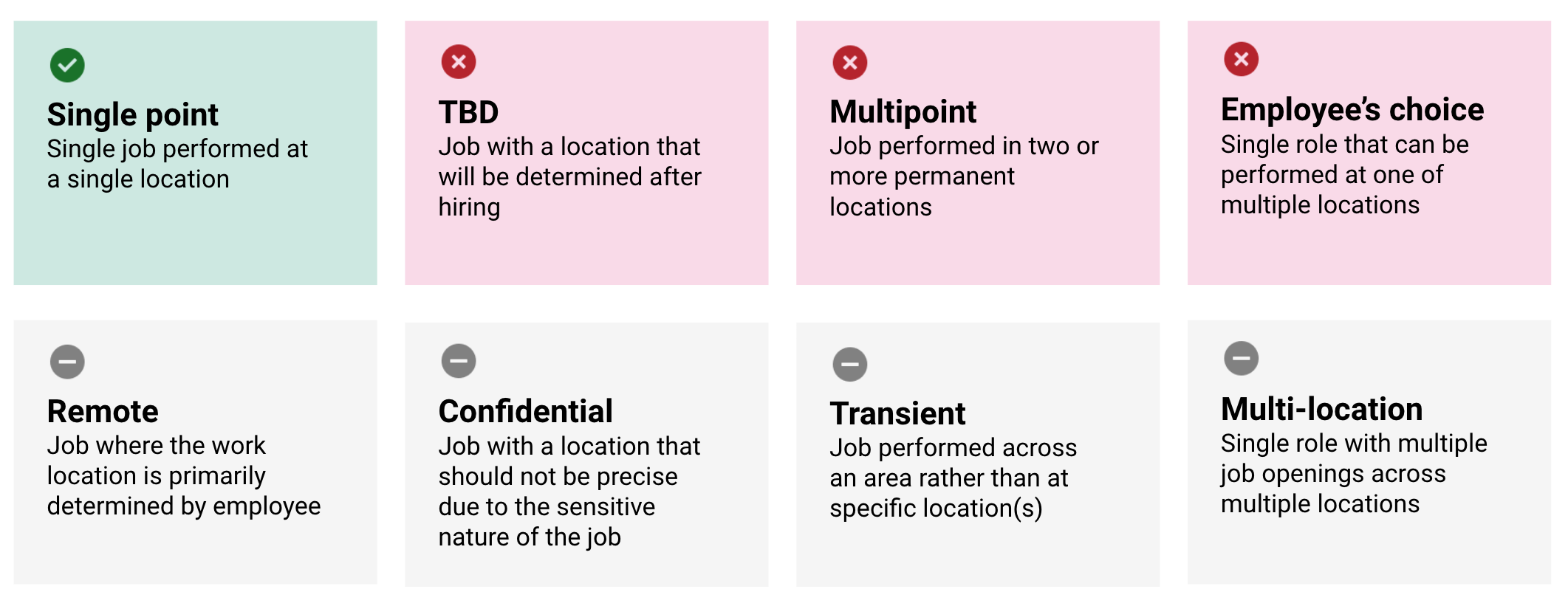
Indeed’s location services are designed for US-based, single-point locations. After that, things break down.
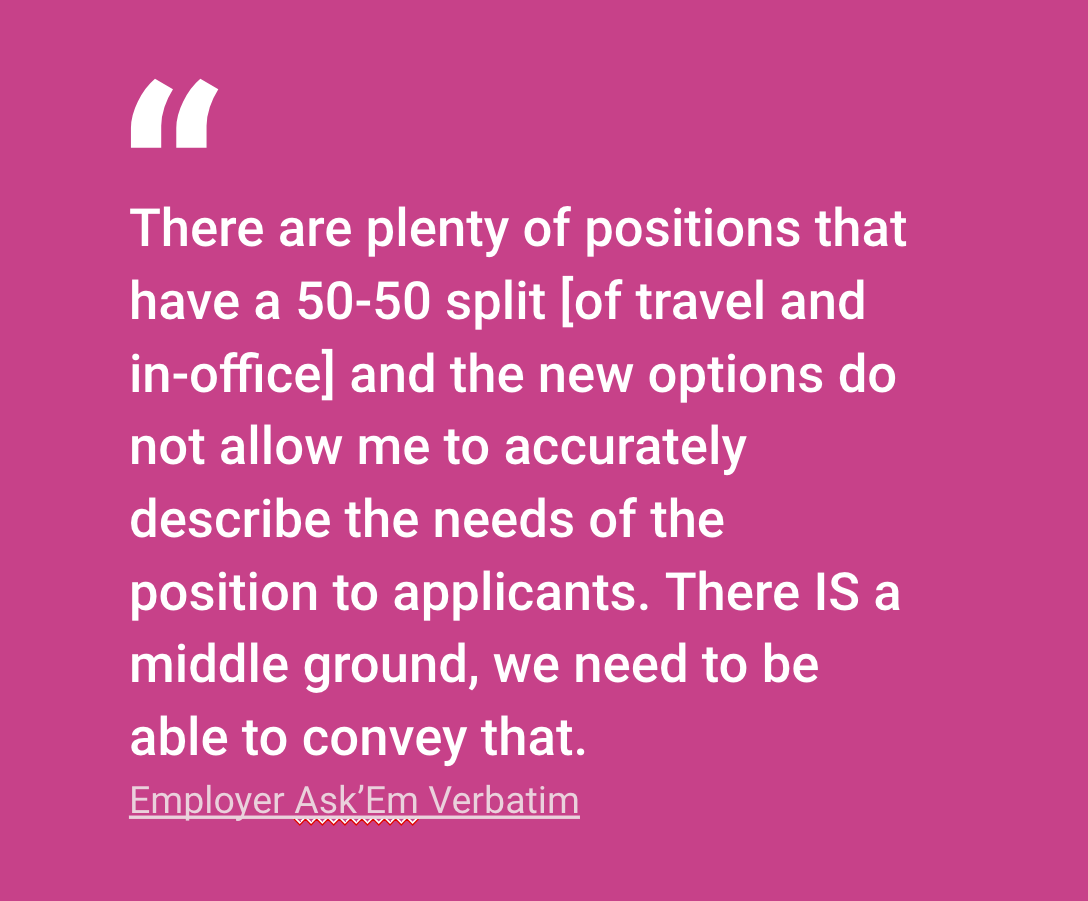
Non-single point and complex location types are not handled well today. It's difficult for employers to convey nuanced location information for jobs that are on-the-road multi-location, hiring across multiple locations, or confidential. In the Hosted funnel, we only allow employers to choose single location, remote, or on the road. On-the-road jobs only allow you to choose one associated location, but many of these jobs are regional or entirely transient.
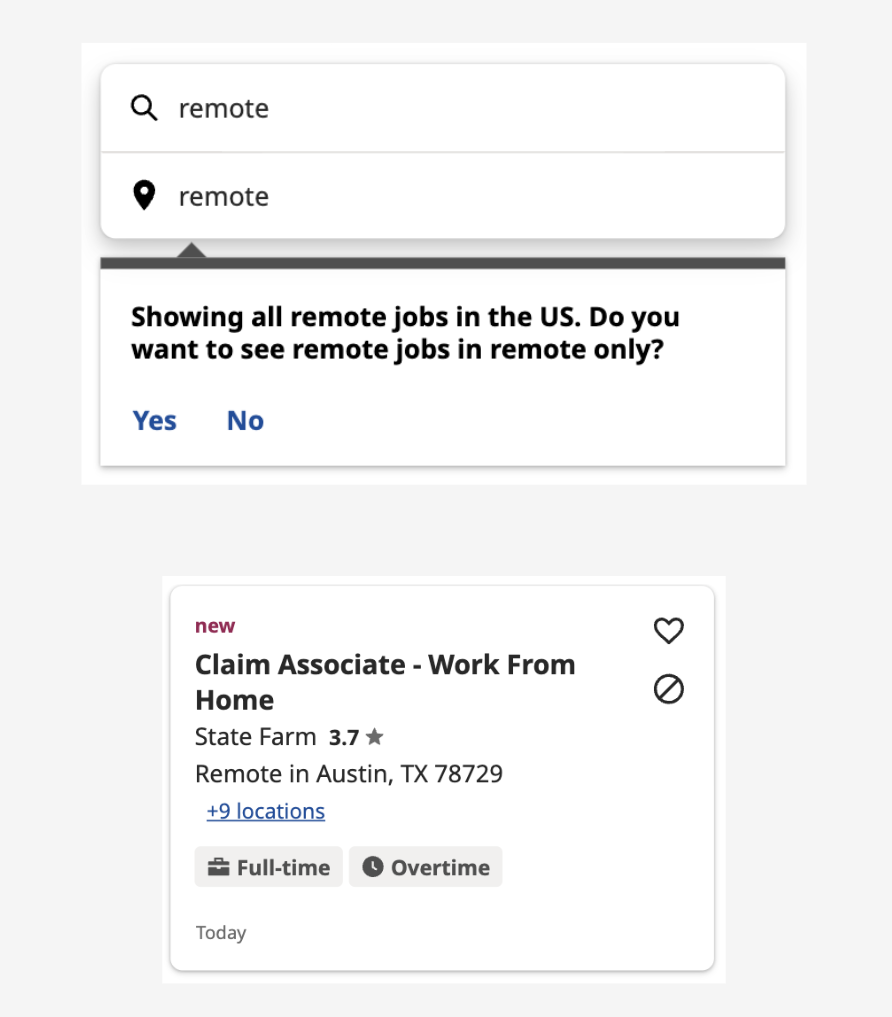
Nearly half of all location complaints are actually remote complaints. For some job seekers, the job being remote is actually more important than the job itself - the top 4 most used queries related to remote work aren’t specific to an occupation (ref). Remote, temporary remote, and hybrid remote are ultimately all attributes with varying degrees of residency or location requirements, but this nuance is not recognized or communicated today.
Push/Pull
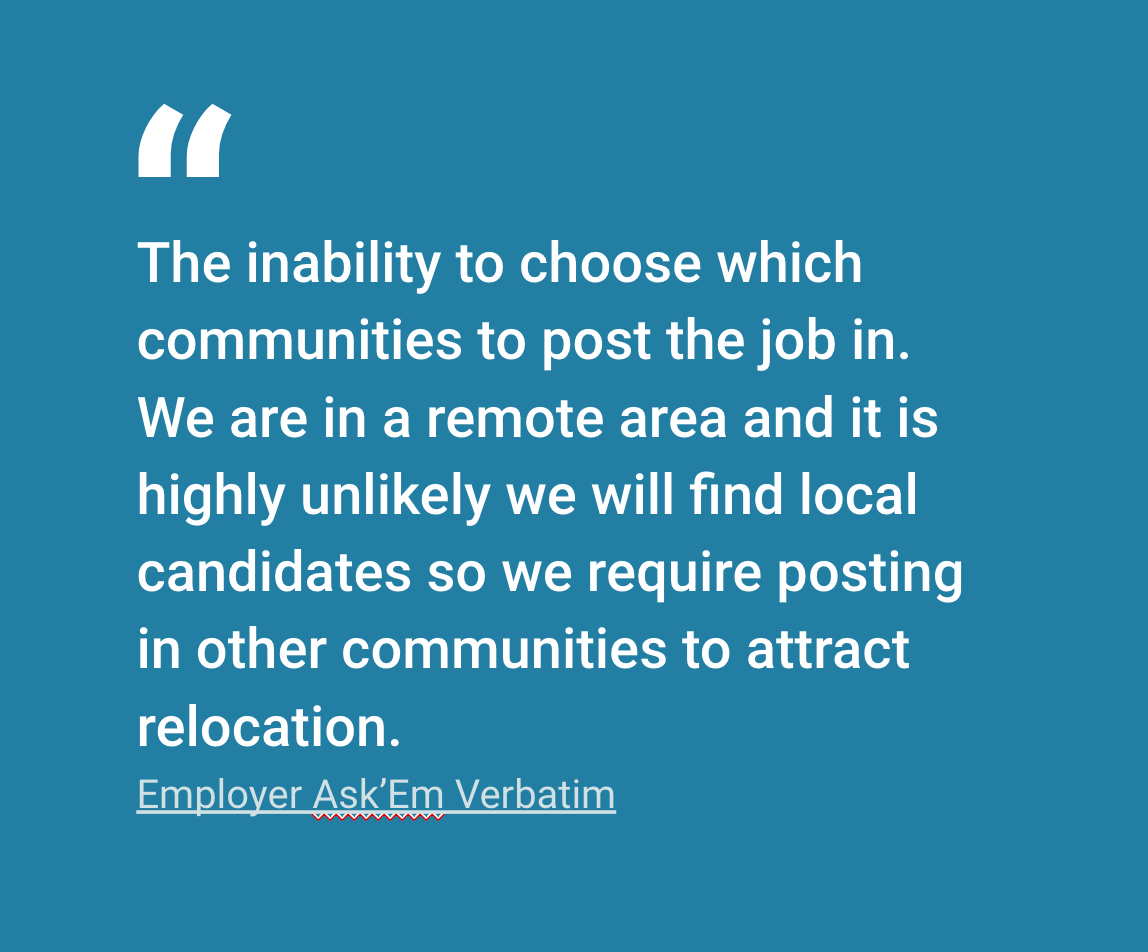
Employers want to tailor their advertising area. There are situations where employers want to target a larger area due to a lack of applicants in the specific job location (e.g. posting a job for Yellowstone National Park). With the removal of advertiser location, employers no longer have the capability to expand their target radius. They also sometimes want to hone their advertising in to a smaller area, because they know from experience that they get better candidates from a smaller radius (e.g. for entry level positions), or have residency preferences for taxes.
Recommendations
We hosted a workshop that brought together representatives from across the company to identify realistic opportunities. Here’s what we recommended:
Company-wide
Bring teams together across GMs to solve problems in a coordinated fashion. Improvements on the employer side should have cascading effects on the job seeker side, rather than being isolated or remaining unfinished.
Employer
Continue iterating on how we capture the location of jobs to include non-single point locations and build out a taxonomy of job location types to support this work.
Separate the location of the job from where the job is advertised, those are different in the minds of employers. Consider monetizing advertising location.
Identify and collect location deal breakers to eliminate egregious matches - for example, does the employer require the job seeker to be legally authorized to work in the country where the job is located? Does the job seeker need to be located in a particular state for tax purposes even if the job is remote? Does the employer sponsor visas? Sponsor relocation?
Job Seeker
Provide job seekers more fine-grained control over their search area, consider adding…
The ability to draw map boundaries, similar to Zillow.
Support commute calculations including the time of day, transportation mode, and cost.
Allow for multiple location searches, for example, close-to-home, remote, and in a dream location where the job seeker would be willing to relocate.
Iterate how we represent job locations in job posts to support new location types and demonstrate them through visual representations like maps.
During the application process, reinforce and confirm job location and commute feasibility.
As a result of this investigation, multiple initiatives were created:
Bridge team that spans GMs to drive coordinated and impactful change
Location relevancy initiative to improve how we make location matches
UI experiments to tweak how we collect and represent locations on both sides of the marketplace.
Explorations to monetize “reach”, an iteration on advertising location